
Drop-in demonstration/discussion: basket weaving and traditional land-management practices in Oxford and Yurok/Karuk communities
(a collaboration with Boundary Brook Nature Reserve)
Monday 11th May 2026, 10am-2pm
Boundary Brook Nature Reserve (map and directions available here)
Drop-in throughout the day to join us for a demonstration of traditional basket-weaving techniques and a discussion of land management practices, led by two expert basket weavers and education specialists from the Yurok/Karuk communities in California, USA. See how some of the intricate basketry items in the Pitt Rivers Museum came into being and have the opportunity to ask the expert makers questions whilst they work. Find out about the materials they use – including how they are grown, collected, and harvested by hand – and the importance of traditional basketry for communities today, and discuss the use of fire in traditional land management practices with these expert makers.
PLEASE NOTE: Whilst there is no individual charge for this event, you must be a member of the Oxford Urban Wildlife Group (available from only £5/year) to access Boundary Brook Nature Reserve (and therefore to attend this event). See the OUWG website for information about how to join and how to book your place for this event.
ABOUT THE SPACE
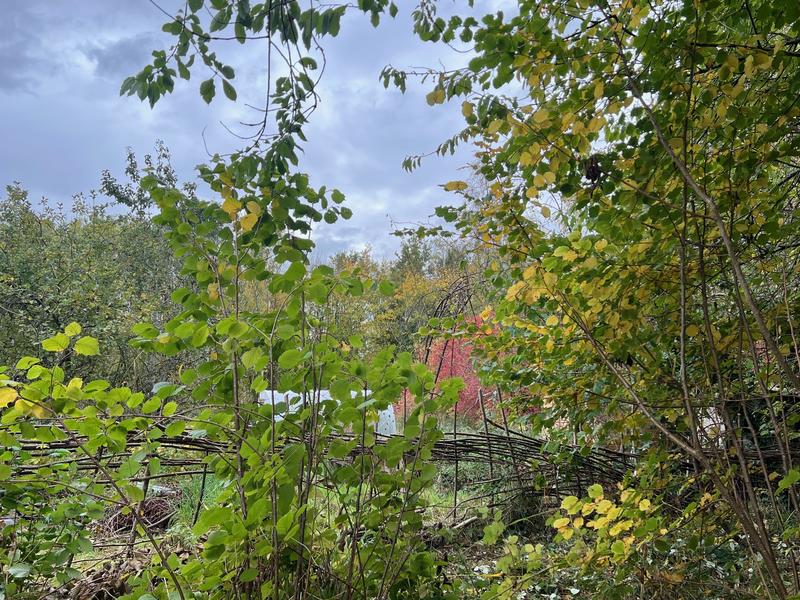
Boundary Brook Nature Reserve is a 3-acre site in East Oxford maintained and stewarded by Oxford Urban Wildlife Group for over 35 years. This oasis of peace in the heart of the city is a thriving habitat mosaic, grassland and high canopy woodland balanced with shrub areas to ensure a site of ecological significance and deepening local community connection with nature. There are 3 ponds and a marsh amongst the glades, meadows and wildflower mounds, 4 hazel coppices, a demonstration wildlife garden and a Forest School area, a seated area, woodland shelter and bird hide. Attention to the seasonal management of the delicate balance of habitats offers benefit for the greatest species range, including the rare brown hairstreak butterfly, slow worms, greater water parsnip and water violets.
Restoration of woodland ground flora is thriving following a grassland enhancement and living libraries project which has also inspired local people and visitors this year to act for wildlife in their own green spaces and other urban areas to join up the urban green mosaic. Conservation work, skills training, species ID, surveying and nature connection events are all offered as part of the OUWG public engagement reach into local communities enhancing people of all ages' access to nature. OUWG offers vital ways for communities to meet with nature at heart, to understand land management and sustainability in a deeply interconnected way with Earth and model decision making and policy which prioritise environmental issues. Futures for species diversity and abundance need new conversations which hold nature in mind. OUWG are passionate to ensure wildlife reserves, green and wild spaces across the city join up to create a cohesive green mosaic, making visible an alternative vision of the city from the perspective of wildlife. The care of Boundary Brook Nature Reserve shows how local people, especially young people, can learn to feel stewardship of local areas of land in which nature and humans can flourish, and we hope to inspire other groups to find sustainable ways of bringing ecology and environment into urban community life as well as offer consultation on nature concerns.
THE PEOPLE INVOLVED
Margaret Lee (Maggie) Peters (Yurok/Karuk) is a traditional basket weaver and regalia maker whose work is rooted in the cultural knowledge and teachings of her family and community. She began her weaving journey in her early twenties, learning from master weavers including Wilverna Reece, Susan Burdick, Bertha Peters, and Loren Bommelyn in Northern California. Through these relationships, she developed not only technical skill, but a way of seeing, learning to read baskets, understand their construction, and carry forward the techniques and intentions of those who came before her.
For Peters, weaving is a lifelong commitment to cultural continuity, identity, and care. She has woven over 200 baskets, with a particular focus on baby baskets (177), which hold deep cultural significance in her community. These baskets are created to cradle and protect infants, surrounding them with culture, security, and belonging from the very beginning of life. Being asked to create a baby basket is an honor she carries with great responsibility, knowing each piece will support families and connect generations to their living culture.
In addition to her work as a weaver, Peters is an educator with over 16 years of experience serving Native students and communities on the Hoopa Valley Reservation. She currently supports the development and implementation of the Native American Studies Model Curriculum through the Humboldt County Office of Education. Across all aspects of her work, she remains dedicated to sustaining Indigenous knowledge, uplifting community, and ensuring that traditional practices continue to thrive for future generations.
Karuk Tribal Member, Lisa Morehead-Hillman is an advocate for the preservation and perpetuation of cultural heritage. With a master's degree in education, she has developed and managed numerous projects for her Tribe, including the USDA NIFA-funded Karuk Agroecosystem Resilience and Cultural Foods and Fibers Revitalization Initiative. Lisa is a 2025 Community Spirit Award recipient of the First Peoples Fund recognized for her commitment to traditional ceremonial cap making and land stewardship. Additionally, she uses her writing skills for outreach, to move policy changes, and to seek funding support for a wide variety of educational, cultural, health, and environmental programs. Knowledgeable in her Native tongue and cultural heritage, Lisa is dedicated to the preservation, propagation and perpetuation of traditional knowledge and practice. She is also a traditional basket weaver.
Hamish Burnett previously taught Art in a vibrant secondary school in London for four years, before retraining as Forest School teacher. He taught the primary curriculum outdoors in West Ham Park, leading a project called Wild Schools whilst designing and planting two new Forest School sites, and currently teaches in a SEND school in Oxford where he leads on outdoor education.
He is increasingly interested on the impacts of the natural environment on children’s play and behaviour. With a lifelong background in gardening and horticulture, he focusses on the design of Forest School areas and structures, woodland planting schemes and creating biodiverse plant assemblages which draw inspiration from nature. He is also a greenwood worker, allowing me to enhance these spaces with the addition of woven hurdles, dead hedging and laid hedges.
Helen Edwards has lived in Oxford for over 35 years, and has been chair of OUWG for the last 6 years. Helen combines a deep love of nature with decades of experience in community inclusion and engagement through creative and ecological means. She is an artist, arts psychotherapist, dancer and environmentalist, having trained in Japan, Indonesia, Europe and UK. Her work brings visionary approaches to education, ecology and community research in an open participatory way to enhance inclusion, cross cultural and inter species perspectives and understanding and to bridge art, ecology and science.
Making the Museum is a three-year AHRC-funded research project based at the Pitt Rivers Museum, Oxford. It is the first major research project in an ethnographic museum to investigate maker identities and agencies across the breadth of its collections. Through detailed analysis of the Museum’s database, associated documentation, objects and archives, it is pioneering a series of maker research fellowships that are transforming our understanding of the knowledge, skills, and cosmologies embedded in objects, as well as their continuing power for people today.
Can't make this event? We're also hosting a public drop-in with Maggie and Lisa at the Pitt Rivers Museum on Wednesday 13th May.

