Afterlives of Captured Objects
In 1932 a seventeen year old Naga girl called Gaidinliu was arrested for leading an uprising against the British in northeast India. She was incarcerated and her possessions were captured by British colonial officers. Those things were then sent to the Pitt Rivers Museum where they have been stored ever since as the ‘Gaidinliu Collection’. This is the first time they have been put on public display.
Over the course of a four year project, researchers from India and the universities of Edinburgh and Oxford made the Gaidinliu Collection accessible to Naga communities using digital methods. The original objects were digitised and ‘returned’ to the three of the states of India where Naga people currently live. When shared with Naga community members via workshops, pop-up exhibitions, creative activities and social media practices, the Gaidinliu Collection took on a new life.
The exhibition tells Gaidinliu’s story through her possessions and their afterlives when reanimated by her family, her followers and Naga communities today. This webpage introduces some of key themes and sections within the exhibition.
Introducing Rani Gaidinliu
(1915-1993)
Born in Manipur in 1915 to a Rongmei Naga family, Gaidinliu became a revered religious and political leader known to many as ‘Rani’ or queen.
In the late 1920s, Gaidinliu and her cousin Jadonang led an uprising in northeast India. Its purpose was to oust the British from the region, stop the spread of Christianity and promote a Naga Indigenous religion. To suppress this movement, the British government in India sent in the army. In 1931, they arrested and executed Jadonang. Gaidinliu went into hiding until she too was captured in 1932. She was just seventeen when she was imprisoned by the British and was only released from jail after Indian independence in 1947.
While she was evading capture by the British army, Gaidinliu had to abandon some of her most valued possessions in the places where she had hidden. Those things were seized by her pursuers and sent to the Pitt Rivers Museum in England.
Gaidinliu’s Clothes
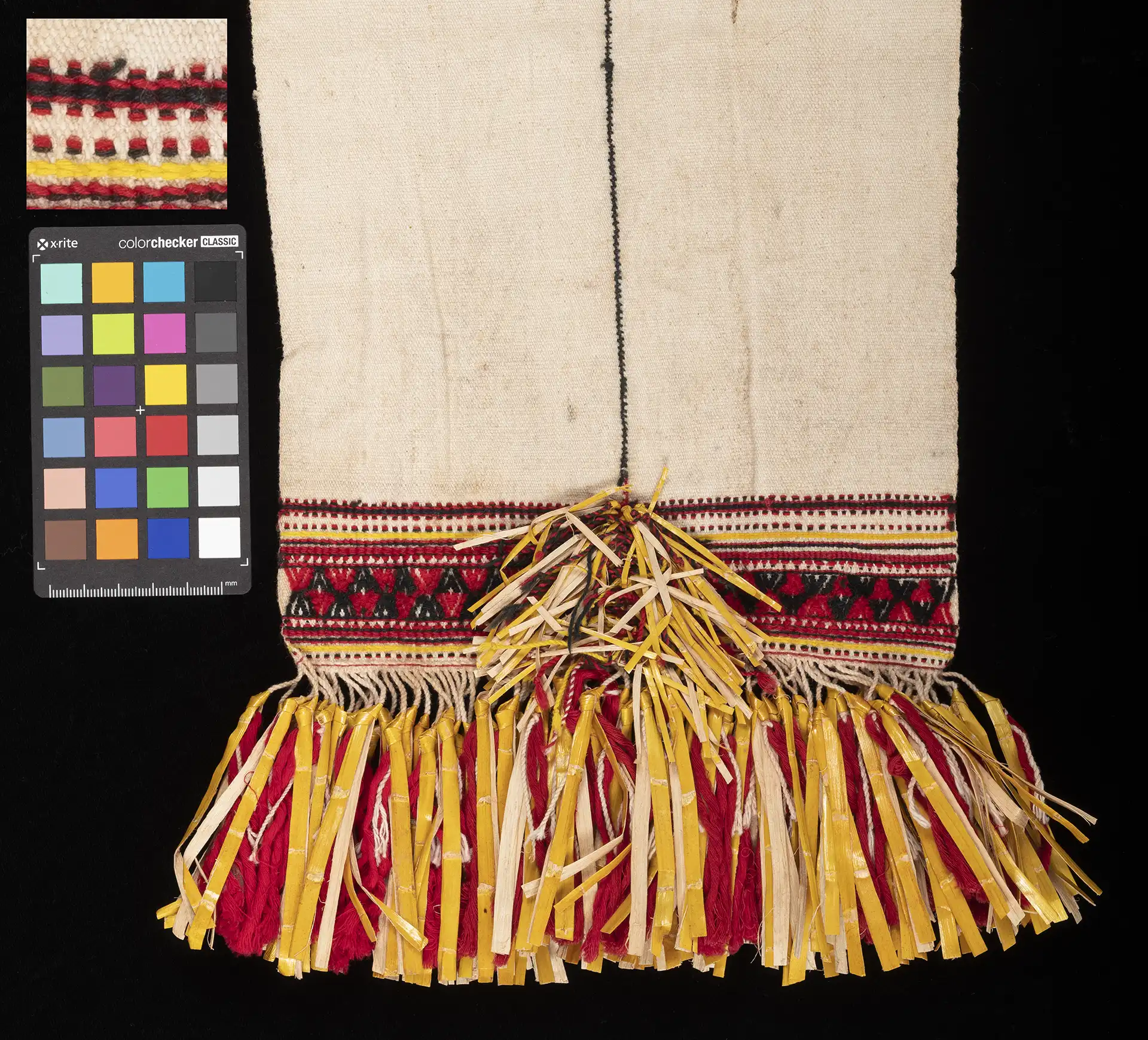
A mannequin in the opening section of the exhibition displays clothes that belonged to Gaidinliu in the way she is likely to have worn them. The fabrics were woven with cotton and coloured with natural dyes. The patterns on these textiles are distinct to the Naga community Gaidinliu belonged to, the Rongmei. They are one of four Naga ethnic groups collectively known as Zeliangrong, who live in the Indian states of Assam, Manipur and Nagaland.
The two textiles were captured by colonial officer and anthropologist JP Mills at Kambiron, a village where Gaidinliu had hidden to escape the clutches of the British army.
Introducing the DiMuse Project:
Decolonising the Museum: Digital Repatriation of the Gaidinliu Collection from UK to India
DiMuse was a research project conducted between 2022 and 2026 that worked with the Gaidinliu Collection to explore the concept and practice of ‘digital repatriation’. Its aim was to engage with Naga communities in northeast India by 'returning' digital copies of the objects in the collection and collaborating with them to share and co-produce knowledge. The project was also designed to evaluate the potential of this form of repatriation within the wider practice of decolonising museums.
The project – and this exhibition – raises challenging questions about colonial extraction, the afterlives of objects from Indigenous communities, and what the appropriate future may be for the Gaidinliu Collection.
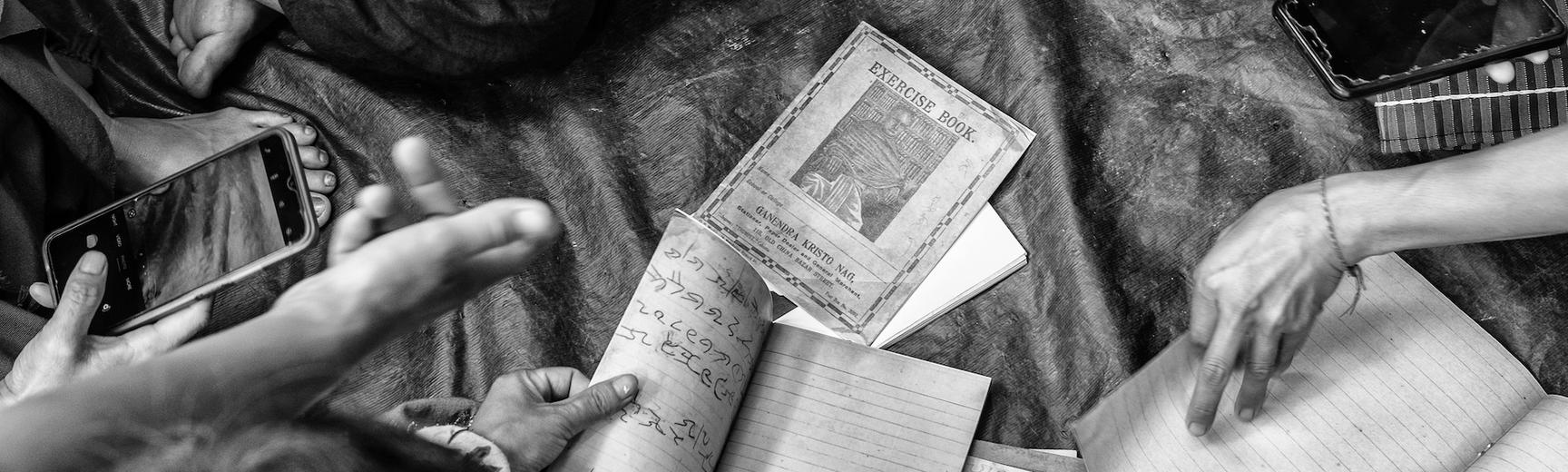
Several films and an interactive screen showcasing the project's online Digital Museum feature in the central section of the exhibition space, giving a flavour of activities that took place in northeast India during the DiMuse project. Using mobile phones, tablets and digital projectors, local project researchers shared digital scans, 3D renderings and film of objects in the Gaidinliu Collection with Naga communities. They also set up a mobile exhibition and created hard-copy replicas of Gaidinliu’s notebooks for people to handle.
The team organised dozens of workshops, pop-up exhibitions and social media groups, to make the Gaidinliu Collection as widely accessible as possible. In addition, creative activities, such as weaving, basket making and drawing, were inspired by it. Community members were interviewed and recorded as they discussed the meanings, value and ongoing significance of Gaidinliu’s possessions, whether in material or digital form. Their views have informed this exhibition. Many of the recordings are available in the DiMuse Digital Museum.
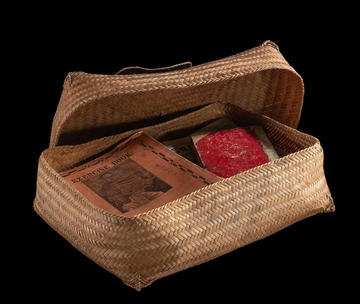
Basket in which Gaidinliu kept the notebooks she had inscribed with her prophetic visions. PRM 1928.69.1570.1-.2
Basket and notebooks
At the centre of the exhibition is a very significant object: the basket in which Gaidinliu kept the notebooks she had inscribed with her prophetic visions as the spiritual guide to her followers. This basket was Gaidinliu’s most treasured possession. She kept it with her at all times, including when she was hiding from the British. But in 1932 Gaidinliu had to abandon the basket and its contents when fleeing from the British army near Hangrum.
For the exhibition the twelve notebooks have been placed on display in a wall case Gaidinliu’s basket are covered in a unique but untranslatable script. In it, Gaidinliu recorded her visions as a prophet. Her followers believe that the script will only be decipherable in a future golden age. In the meantime, they treat her notebooks as sacred objects.
Although deriding her writing as “meaningless scribbling”, the colonial anthropologist who collected these notebooks, JP Mills, recorded that it “gave her immense prestige” in her community. This may explain why he seized the basket and notebooks as part of British efforts to suppress the religious and political movement that Gaidinliu led.
Reproductions of the notebooks are available to browse on the plinth under the screen that also shows a short film about Naga community members responded to the ‘digital return’ of Gaidinliu’s notebooks. Digital copies of Gaidinliu’s notebooks have been deposited with family members and relevant Naga communities in India, and the entire contents of the DiMuse Digital Museum will be presented to them on USB sticks for their use in the future.

Pilgrimage to Bhuban Cave, still from a film by Tarun Bhartiya
Pilgrimage to Bhuban Cave
The journey through the exhibition includes a dedicated screening of a film by Tarun Bhartiya documenting an annual pilgrimage made by Zeliangrong Nagas to Bhuban Cave in Assam. The cave is a sacred site for Gaidinliu’s followers, as it is where she herself worshipped and discovered elements of the script she developed in her notebooks. The footage shows devotees making the challenging journey to the cave to make offerings, pray and remember Gaidinliu.
Tarun Bhartiya was an award-winning documentary film maker, poet and activist. Starting in 2023, he filmed and photographed the DiMuse project and the activities of followers of Gaidinliu at sites across northeast India. The Bhuban Cave film shown here is a rough cut for the documentary he was making about the project at the point of his untimely death in 2025. We are displaying some of Tarun’s photographs and film in this exhibition as testimony to his talents and in his memory.
Temple Textiles
Returning to the central section of the exhibition, there is display case showing textiles presented on two small mannequins. In 1931, British military and colonial officers occupied Kambiron as part of their efforts to suppress the Naga uprising led by Gaidinliu and her cousin Jadonang. At the centre of the village was a temple dedicated to the religion they led and where a pair of dressed male and female clay figures were located.
As a colonial officer reported: “We took out the gods, photographed them and destroyed them”, but the textiles they were dressed in were retained by JC Higgins and JP Mills. They are displayed here along with a photograph taken of the figures before they - and the temple - were destroyed.
These articles were collected by J.C. Higgins (and J.P. Mills), with the Cachar Road Column in February - March 1931. This force was sent to deal with the Kabui "Messiah" named Jadonang and his priestess Gaidinliu. In one of their temples in Kambiron village two clay (painted) statuettes of a god and goddess were found, wearing these cloths (identified by photographs taken on the spot). These two figures bore a strong resemblance to Jadonang and Gaidinliu. The images (2 to 3 feet high) were destroyed. Such gods were not of Naga type; the idea was borrowed from Hinduism on the plains. The cloths were of the pattern worn at dances and festivals.
Text from historic archive labels
Decolonial Display Methods
Since this exhibition relates to a period when India was a British colony, it includes material written by colonial officers, anthropologists and curators using language and assumptions that were current in the 1930s. This means that some prejudiced and discriminatory language is present. We have reproduced it here to acknowledge and challenge the past rather than to cause offence. Material of this sort is displayed on the original catalogue cards from the museum’s archives and in labels printed in a retro typewriter font, so that visitors can choose to read them or not.
In contrast, labels written in consultation with members of contemporary Naga communities is presented on yellow panels throughout the exhibition. We have experimented with these approaches as part of our efforts to critique and decolonise conventional museum methods.
Personal and Ritual Objects
Towards the front of the exhibition is a display case featuring items taken from Gaidinliu.
Protective Objects
As a woman with great spiritual powers, Gaidinliu used objects to protect herself from the British. A stick with a monkey skull, displayed in the exhibition, is said to have been used for warding off evil spirits. It was found above Gaidinliu’s bed when soldiers entered one of her hiding places after she had fled. Small wooden clubs were traditionally used by Nagas to cast an omen on an enemy. The British believed that Gaidinliu had deployed the three examples included in the exhibition against them.
Body Ornaments
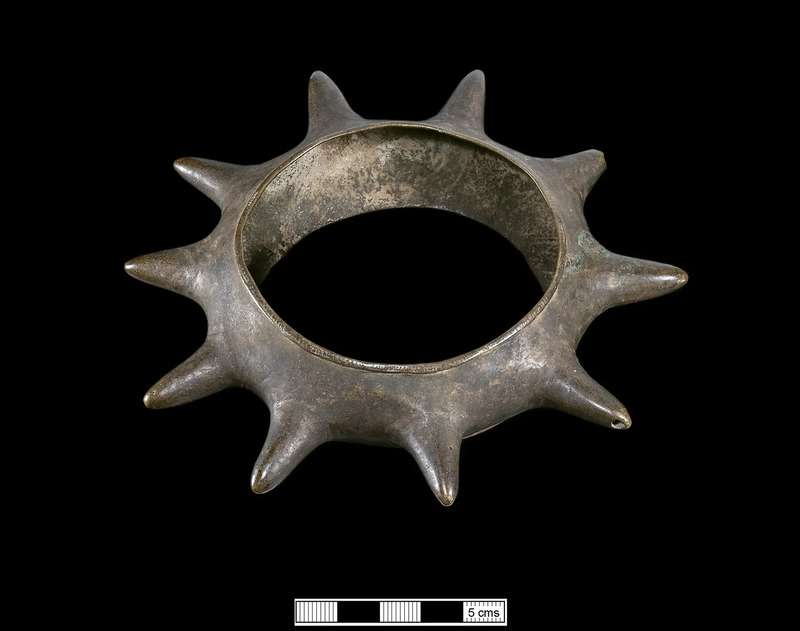
The two spiral arm bands in this display are Gaidinliu’s personal body ornaments. She probably only wore them on special occasions, just as members of her community, the Rongmei, still do today. In contrast, the form of the spiked metal bangle (originally one of a pair) is associated with Ao or Konyak Nagas. It may have been gifted to Gaidinliu by a member of one of those groups.
Gaidinliu’s Legacy
Following her release from prison in 1947, Gaidinliu became a prominent public figure working for the upliftment of her people. She acted as the spiritual guide for followers of Heraka, the Indigenous religion she led, and as the head of a political movement advocating for recognition of a Zeliangrong Naga homeland across three states of northeast India. In 1982 she was awarded one of the highest honours of the Indian government: the Padma Bhushan.
Since her death in 1993, Gaidinliu has continued to be celebrated as a charismatic female Naga leader and an important figure in the anti-colonial movement that led to Indian independence.