News
Journalists should contact press@prm.ox.ac.uk for further details and images concerning the Museum, its collections, research projects, events and activities. Download our press releases.
Inaugural Te Māori Fellows selected for prestigious Oxford University residencies 23 September 2026
Digital heritage researcher Chanel Coromandel, master weaver Hamuera Manihera and cultural interpretation expert Paora Tibble have been selected from more than 100 applicants to undertake a prestigious research residency at Oxford University’s Pitt Rivers Museum. Launched earlier this year, the Te Māori Fellowship is a partnership between Te Māori Manaaki Taonga Trust, Te Wānanga o Aotearoa, and the Pitt Rivers Museum. It gives Māori cultural leaders the opportunity to lead research and apply mātauranga Māori to Pitt Rivers’ extensive taonga Māori collections. Find more information here.
A Path Home: The Return of Naga Ancestral Remains to the Naga Homeland 5 September 2026
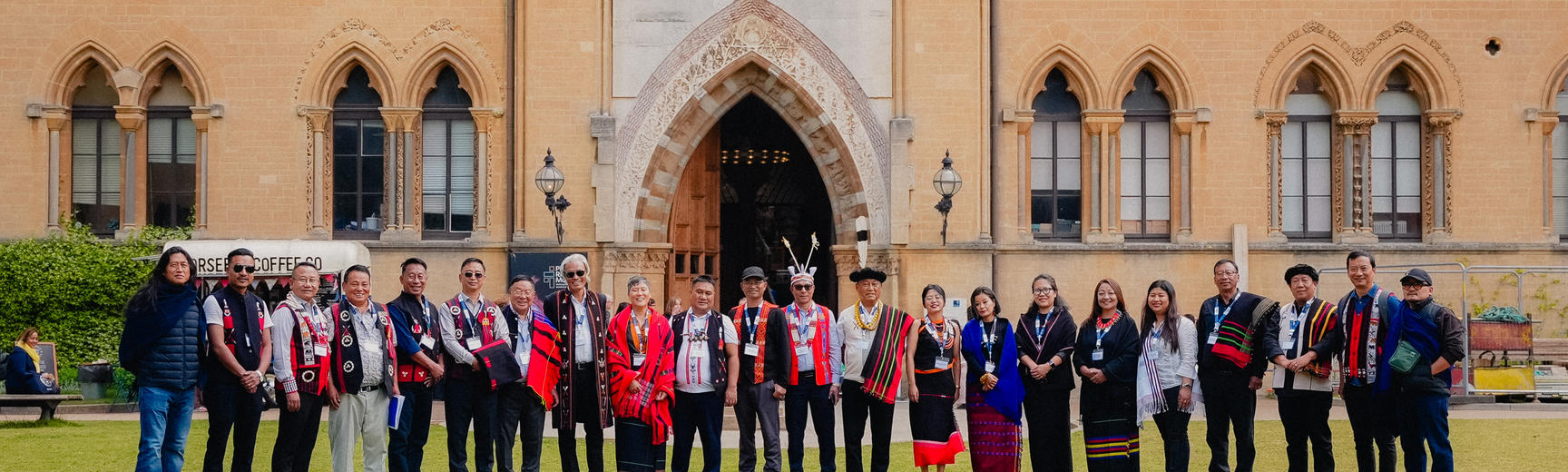
Thirty-nine Naga ancestors will soon begin their journey home from Oxford to Nagaland. This is the culmination of a Naga-led process of dialogue, research and reconciliation that began in 2020, supported by the Forum for Naga Reconciliation, in collaboration with the Pitt Rivers Museum, a process the Naga partners describe as not an ending but as a step on the longer path towards healing.
For more information, see: https://www.prm.ox.ac.uk/a-path-home.
Applications are now open for two Te Māori Fellowships 29 June 2026
Applications are now open for two Te Māori Fellowship: Pitt Rivers Museum Curatorial Residencies. Delivered in partnership with Te Wānanga o Aotearoa and the Pitt Rivers Museum, the Te Māori Fellowship is an international professional development opportunity for two emerging and established Māori curators to participate in a six-week residency at the Pitt Rivers Museum.
Two fellowships are available – one funded by Te Māori Manaaki Taonga Trust and one funded by Te Wānanga o Aotearoa (open to Te Wānanga o Aotearoa kaimahi and tauira only). The residencies will take place from 11 October to 30 November 2026. Applications close on 20 July 2026.
For more information and application details, please see https://www.temaori.nz.
Pitt Rivers Museum awarded £55,000 from DCMS and the Wolfson Foundation 10 April 2026
The Museum is delighted to announce that it has been awarded £55,000 by DCMS and the Wolfson Foundation towards Phase 1 of its essential refurbishment and accessibility plans, for which we are truly grateful. The museum's ambitious multi-phase masterplan for renewal seeks to enhance its galleries, work spaces, displays and interpretation of the collections, leading up to our 150th anniversary in 2034. Find more information here.
Reimagining Ceremony and Welcome in the Museum 16 December 2025
We are delighted to announce that Art Fund has awarded Pitt Rivers £47,500 as part of the Reimagine programme. This grant will fund Reimagining Ceremony and Welcome, an innovative project to co-design new culturally informed protocols and symbolic forms of welcome, embedding ceremony and ritual into museum practice and helping to transform the museum’s organisational culture. Building on a decade of work around access and decoloniality, it will involve stakeholder consultation, artistic commissioning and sector sharing through toolkits and public events, re-imagining and honouring the collections as living cultural presences and reframing the museum as a site of care, reciprocity and ethical hospitality.
An Award Filled Day! 15 May 2025
On 15 May 2025 the Maasai Living Cultures Project scooped two major awards, reflecting the significance of this innovative partnership. In the University of Oxford Vice-Chancellor's Awards, it was announced as winner in the 'Making a Difference Globally' category, against stiff competition from other inspiring, groundbreaking and life changing projects taking place in the University. In a glittering ceremony in London later in the day, it was then announced as winner of the Museums + Heritage Partnership of the Year Award. The judges described the project as: "Brave, sensitive, and internationally significant, this partnership sets a new standard for genuine collaboration. Through exceptional dialogue and deep mutual respect, it has delivered outcomes with impact far beyond the project itself — offering vital lessons for the sector at a pivotal moment in museum practice."
Find out more about the project at https://www.prm.ox.ac.uk/maasai-living-cultures.
Hair of Tasmanian Aboriginal People Returned Home 24 March 2025
The Pitt Rivers Museum is returning five ancestral remains to the Tasmanian Aboriginal Centre. The five remains are all samples of human hair taken during the period of Imperial expansion and the colonisation of Tasmania without the consent of Tasmanian Aboriginal people. The hair was transferred into the care of the Tasmanian Aboriginal Centre during a small ceremony on Monday 24 March 2025. Two Tasmanian Aboriginal delegates travelled to Oxford to receive the hair samples and take them home.
Three of the hair samples had entered the museum collections as transfers from other departments of the University in 1886; one was donated in 1914 and the other was acquired at an unknown date. None of the remains have been on display in the Museum. The identities of the Tasmanian Aboriginal people from whom the hair was taken are not known.
Statement from Prof. Laura Van Broekhoven, Director of the Pitt Rivers Museum, in response to Museum hides mask "not for women's eyes" article in the Telegraph, 18 June 2024:
"This is a non-story. The Igbo mask has not been removed from display, as it was never on display and no one has ever been denied access to it.
The Museum’s online collections now carry a cultural context message, which allows users, especially those from different cultures around the world, to actively choose which items they wish to see, and which to remain blurred from view. Only around 3,000 of our object records carry such a warning, so less than 1% of the overall collection. No digital assets are withheld from view from women."
Background information:
-
Contrary to an article which appeared in this morning’s Daily Telegraph, the Pitt Rivers Museum is not withholding an Igbo mask from display because it should not be shown to women. The mask in question is in storage in the museum, and there is no record of it ever having been put on public display. The museum displays around 50,000 items from its overall collection of around 350,000 objects.
-
Some collections and imagery of them are not appropriate for general public access online, and in this case, direct contact with the museum staff is encouraged to discuss the research need to consult them. Overwhelmingly this is for human remains, graphic or personal content, but also for copyright or other legal reasons. Only about 2,200 digital assets out of over 250,000 objects (less than 1%) are withheld from public view in this way.
-
The primary purpose of the sensitivity warnings is to protect people who may find these images culturally distressing, rather than from stopping visitors or researchers seeing them or doing research on them. We have a global collection and as such, have a responsibility to more than one community. Users of the online collections database can choose whether to proceed with or without these warnings.
-
The Museum is not working with groups to ensure that that objects are ‘selectively displayed’. We are working with groups to allow them to decide how their own cultures are represented.
-
A 15th century Indian statue has been claimed for return from the Ashmolean Museum collection, not the Pitt Rivers. Further information on this is available here.