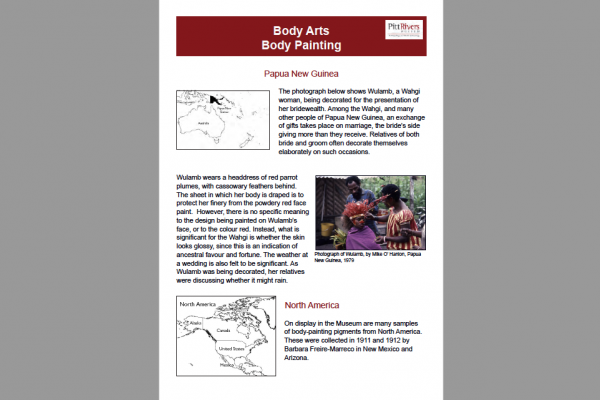
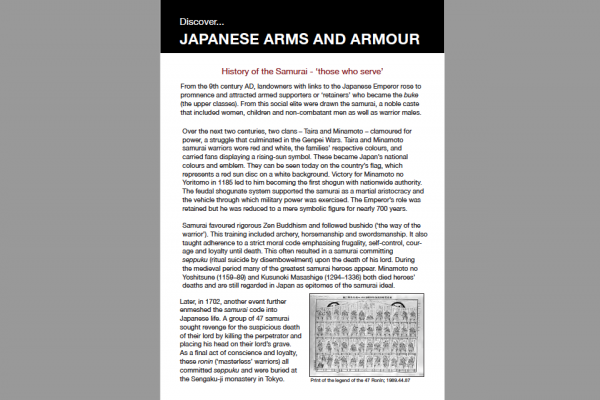
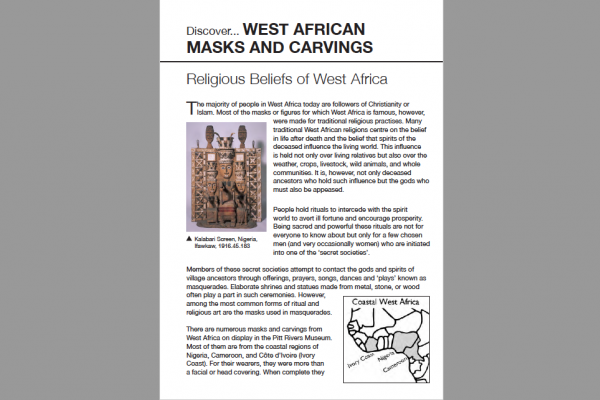
Defensive Weapons
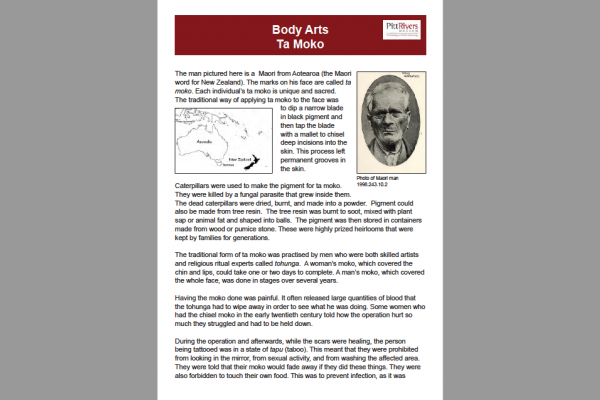
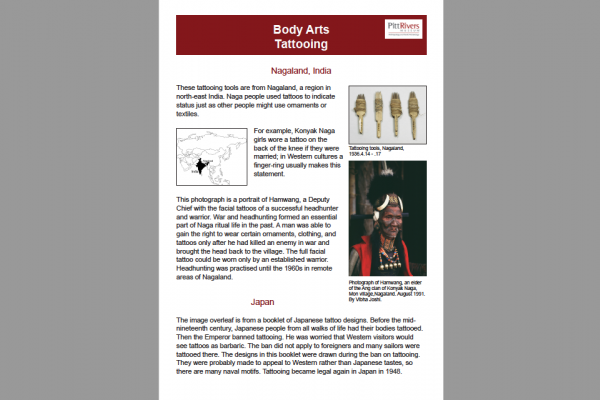
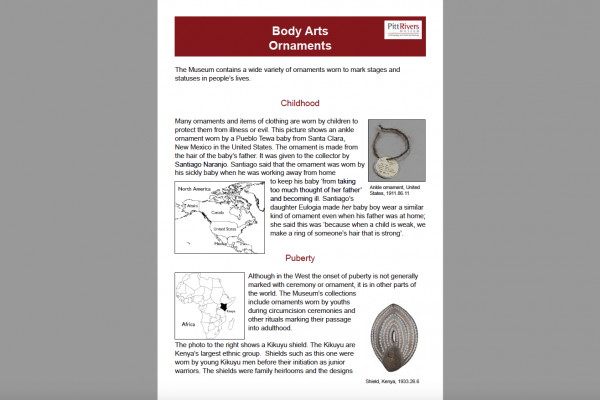
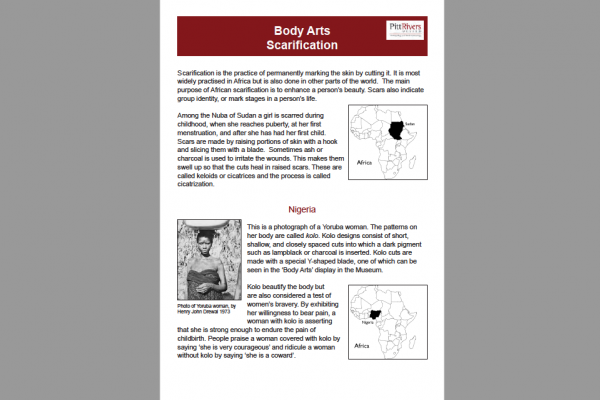
The technological and tactical evolution of warfare can be broken down into two equal, basic forces; ways to kill people and ways to keep people from being killed. The latter is what we term ‘defence’. Of course, the use of any object to protect oneself from injury can be termed, ‘self-defence’, be it a saucepan or a chair to hide behind. However, defence was most commonly and effectively practised through objects designed for purpose, namely, shields and armour. This specificity means shields and armour are rare examples of weapons of war that have not evolved from agricultural or hunting tools. It is important to remember that shields and armour are weapons, since a weapon is termed as any implement used in combat.
Usage
Shields and armour were used alone or together depending on a variety of
factors. For the peoples of the East African plains or the Western
Australian deserts, shields were the bedrock of their defensive systems,
extensive armour being impractical in the intense heat. Even in temperate
climes, full armours could be heavy and restrictive to move in, a fatal flaw
if a quick reaction to a sword or incoming projectile 
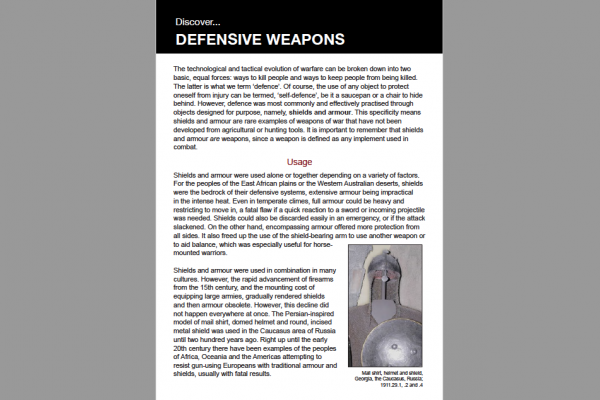
PMail shirt, helmet and shield, Georgia,
the Caucasus, Russia. 1911.29.1, 2 and 4was needed. Shields
could also be discarded easily in an emergency or if the attack slackened.
On the other hand, encompassing armour offered more protection from all sides.
It also freed up the use of the shield-bearing arm to use a weapon or to aid
balance, especially useful for horse-mounted warriors.
Shields and
armour were used in combination in many cultures. However, the rapid advancement
of firearms from the 15th century and the mounting cost of equipping large armies
gradually rendered shields and then armour obsolete. However, this decline did
not happen everywhere at once. The Persian-inspired model of mail shirt, domed
helmet and round, incised metal shield was used in the Caucasus area of Russia
until two hundred years ago. Right up until the early 20th century there have
been examples of the peoples of Africa, Oceania and the Americas attempting to
resist gun-using Europeans with traditional armour and shields, usually with
calamitous results.
Thames Valley Police riot shield,
Oxfordshire.1993.21.2
The late 20th century saw
a renaissance in body defence. Science caught up with ballistics to develop resistant
(though not always ‘bullet proof’) equipment. Riot police today are issued
with protective vests and
polycarbonate shields to tackle potentially violent situations. It is interesting
that as well as new materials such as reinforced metals, fibre-glass, ceramics
and plastics, modern armours also use specialised nylon-based textiles. Armours
have, in a sense, come full circle and are not totally removed from the leather
and fibre versions used thousands of years earlier.
Shields

Basketry shield, Solomon
Islands, 1895.22.196True shields have some form of grip. This is usually a hand-grip set into
the back or a larger strap that can be hooked through the arm or looped over
the shoulder. Shields have been used on every continent since early
times, producing a rich variety of shapes, weights and styles. Materials
used to make shields include metal, wood, wickerwork, plastic, leather, hide,
skins and plant fibres, as well as decorative additions such as metallic
fittings, paint, lacquer, shell, hair, jewels and fabric.
There are three principal types of shield:
- the circular shield, usually convex in front, with a boss in the centre such as those found in Ethiopia, or the famous Indian dhal, with four bosses.
- the rectangular or elongated oval shield, either flat or curved outward,
popular in Australia and Melanesia.
- the kite or triangular shield tapering to a lower point, which was the prevailing form in medieval Europe.
Armour
The rich and varied types of armour produced are all stylistic interpretations
of a specific type of clothing. They are also works of engineering, representing
different solutions to the problem of bodily protection within technological
restraints. As with shields, there was no single ‘ideal’ design, nor was
metal universally employed. Craftsmen often had to use whatever natural
materials were available and possessed a varying sophistication of metalworking
technologies. But differences in design could sometimes be conscious decisions,
since defensive measures were often dictated by the type of weapons and tactics
used by the opposition.
Brigandine Armour, China, early 19th
century, 1884.31.27
Whatever type of armour was used, it underwent rigorous, real-life refining and testing to make sure it did what it was meant to, namely, save your life.
Some armours were thick and protected large parts of the body, although they were so heavy that the wearer could not run very far or fast. An example of this is brigandine armour, which consisted of large plates riveted to the underside of a thick garment.
Conversely, it could be argued that the greater mobility and sensory awareness
provided by a lighter and more flexible armour was worth the increased vulnerability. Bark
belts and carved wooden shields were the sum defence employed by the warriors
of the Papuan Gulf. 
Buffalo hide cuircass, Sema
Naga people, Assam, India
1923.85.545Similarly, this buffalo-hide cuirass from India
was unrestrictive and covered the soft belly and vital organs but offered
no protection to the chest, shoulders or neck.
One construction that prevailed in various
designs through history, was a ‘glancing surface’ to deflect blows. Scale armour
took its inspiration from the protective skins of fish and reptiles. 
An example of how lamellar
armour is laced together.Small flat
pieces of leather, iron, metal or horn were attached to an undergarment in vertically
overlapping layers over which a blade would ‘skim’.This evolved into lamellar
armour, consisting of tightly laced horizontal rows of plates, making it less
likely for a single piece to be detached. This design was widely used by warriors
of Byzantium, the Eurasian Steppe and the Far East.
A widely used deflective armour
was (chain) mail, consisting of linked metal rings forming a rippling surface

Detail of coconut fibre armour, Kiribati,
Melansia. 1941.1.2.74of miniature convex arcs. At approximately 10kg,
a mail shirt wasnot as heavy as full plate armour, which offered greater protection
against piercing. Yet plate armour too had its weaknesses - it could buckle or
communicate the full force of a blow to the body, causing internal injuries. Other
armours were designed to absorb impact. For example, padded fibres received
and dissipated a blow, even though such ‘soft’ creations would not stand up to
a high-velocity arrow or bullet. In Kiribati, Melanesia, entire suits were made
of woven coconut fibre to form a very tough matting.
More than just defence

Pronged wooden
shield, Igorot or
Kalinga people,
Philippines,
South East Asia.
1929.71.2The term ‘defensive weapon’ is something of a misnomer.
Many weapons were multi-purpose and defence and attack often blurred in warfare.
For example, some shields had pouches on the reverse side to conceal daggers
or pistols. Others were long and thin for bludgeoning or for parrying the blows
of a club or sword. Some had sharp projections that could be used aggressively.
This Philippine shield has three prongs on the upper edge to trip up an opponent.
The two prongs on the lower edge would then be used to pin his neck to the
ground so that the head
could be taken.
The Importance of Decoration
It is important to gain a psychological advantage in warfare. Armour and
shields had fairly large surface areas that could be embellished with messages,
symbols and decorations to encourage and inspire the wearer or intimidate
his opponents. Bornean warriors would often adorn their shields with
the hair of slain enemies. Some Indian shields were painted with hunting
scenes to emphasise the role of the enemy as the doomed prey. In Western
New Guinea, a man went into battle to avenge the death of a relative. 
'Demon' helmet, Iran (Persia)
1966.1.1359His
shield would bear threatening, masculine motifs and depictions of the dead
relative. The enemy interpreted this as facing two men.
Helmets could increase the wearer’s self-confidence, reinforcing a sense of allegiance through the use of recognisable politico-cultural shapes, from the Roman galea to Germanic morions to First World War ‘tin-pots’. They could make the warior more frightening (especially those with plumes, horns and visors, etc), or even imbue him with magical powers. This Persian helmet bears the face of a demon or Div. In mythology, the great Persian hero, Rostam, defeats the king of the Divs and thereafter wore a helmet with an image of his victim’s face. The wearer of this helmet would therefore have been considered to possess the heroic qualities of Rostam.
The symbolic and presentational aspect of shields, armour and helmets is illustrated by the way many were still used as ceremonial or ritualistic items long after they disappeared from the battlefield.
Further Reading
EGERTON, LORD, OF TATTON, Indian and Oriental Armour, London: Arms & Armour Press (1896)
ROBINSON, H. R., Oriental Armour, London: Herbert Jenkins (1967)
Sources
FERDOWSI, Shahnameh - The Book of Kings, Tehran: University of Tehran (1997)
KOCH, G., The Material Culture of Kiribati, Suva: University of the South Pacific (1986)
SHAKESPEAR, J., The Lushei Kuki Clans, London: Herbert Jenkins (1912)
TREGEAR, M., Chinese Art, London: Thames & Hudson (1997)
WAITE, D., ‘Shell-Inlaid Shields of the Solomon Islands’, in S. Mead and B. Kernot (eds.), Arts and Artists of Oceania, Wellington: Dunsmore Press (1983), pp. 114-61
Fact sheet compiled by:
Helen Adams, Interpretation Officer
DCF Cutting Edge Project
2007
Download print version of this fact sheet
(to view pdf files Acrobat Reader is required)