Treatment of the Dead
Preparing for eternity
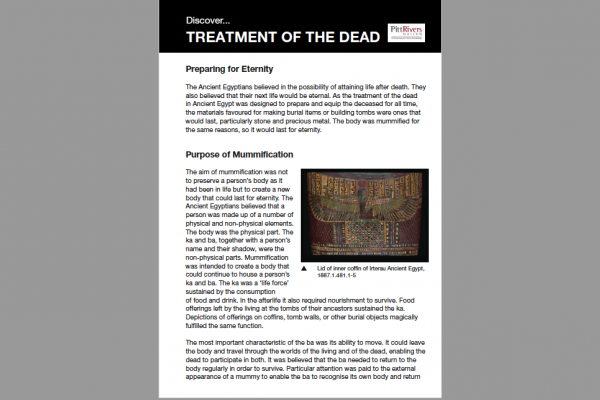
The Ancient Egyptians believed in the possibility of attaining life after death. They also believed that their next life would be eternal. As the treatment of the dead in Ancient Egypt was designed to prepare and equip the deceased for all time, the materials favoured for making burial items or building tombs were ones that would last, particularly stone and precious metal. The body was mummified for the same reasons, so it would last for eternity.
Purpose of mummification
The aim of mummification was not to preserve
a person’s body as it had beenin life but tocreate anew bodythat could
last for eternity. The Ancient Egyptians believed that a person was made
up of a number of physical and non-physical elements. The body was the
physical part.The ka and ba, together with a person’s name and their shadow,
were the non-physical parts. Mummification was intended to create a body
that could continue to house a person’s ka and ba. The ka was a ‘life force’
sustained by the consumption of food and drink. 
Lid of inner coffin of Irterau Ancient Egypt,
PRM 1887.1.481.1-5In the afterlife it also
required nourishment to survive. Food offerings left by the living at the
tombs of their ancestors sustained the ka. Depictions of offerings on coffins,
tomb walls, or other burial objects magically fulfilled the same function.
The most important characteristic of the ba was its ability to move. It could
leave the body and travel through the worlds of the living and of the dead,
enabling the dead to participate in both. It was believed that the ba needed
to return to the body regularly in order to survive. Particular attention
was paid to the external appearance of a mummy to enable the ba to recognise
its own body and return to it safely. The body, a combination of ka, ba,
name and shadow, was thought to make a person complete in this life and in
the next. The dead could only fully enjoy eternal life if all the different
parts survived.
Ancient Egyptian coffins
Coffins themselves were placed in secure tombs, which protected mummified
bodies from intruders and from the elements. The texts and pictures on Egyptian
coffins were intended to provide their owner with the magical assistance and
knowledge needed to survive and prosper in the afterlife. Throughout Ancient
Egyptian history, despite many changes in emphasis and fashion, there were
two major themes in the decoration of coffins. These reflected two of the most
important strands of belief concerning the afterlife. The first theme concerned
the sun god. According to one major creation myth, the sun god was the maker
of the universe. Egyptians hoped that after death they might ascend to the
sky and, once there, accompany the sun god on his journey through the sky by
day and through the underworld by night. In this way they could be rejuvenated
and reborn with the sun each morning in a repetition of the moment of creation.
The other major theme of coffin decoration incorporated elements drawn from
the myth of Osiris. The Egyptians believed that the god-King Osiris was murdered
by his brother Seth. Osiris was restored to life by his wife Isis, with the
aid of her sister, Nepthys, and became King of the Underworld. Osiris’ son
Horus later avenged his father’s death and succeeded him as the king of this
world. Egyptians hoped that by linking themselves with Osiris, they might achieve
a second life after death, just as he had done. The dead were often referred
to as ‘The Osiris [name]’.
The sky goddess Nut was the mother of Osiris and an important protector of
the dead. As the dead person was identified with Osiris, coffins came to be
identified with Nut. This placed the deceased back inside their mother, from
where they could be reborn. As a sky goddess, Nut could also be identified
with the coffin lid, laying herself over the deceased, just as she stretched
herself over the world, and protecting the dead person from harm. Nut can be
seen on the painted coffin of Irterau, a mummy on display in the Pitt Rivers
Museum. Irterau lived in or around Thebes (modern Luxor) in southern Egypt
more than 2,500 years ago. On Irterau’s inner coffin lid, Nut’s body and face
have been painted green, a colour associated with new life. The faces of the
dead were often painted yellow to make them appear like divine beings, which
were thought to have golden skin. On the finest coffins, real gold would have
been used.
Canopic Jars

Canopic jar and stopper, Ancient
Egypt
PRM 1884.57.15 and 1884.57.17.1
Canopic jars were referred to simply as ‘jars of embalming’. The modern term ‘Canopic’ comes from the town of Canopus in the Nile Delta where Classical writers tell us the local god was depicted as a jar. This jar (right) has no direct connection to embalming jars but the term has become popularised nonetheless.
As the aim of mummification was to transform the body for its new existence
rather than to maintain it as it had been in life, internal parts of the
body could be removed without endangering a person’s chances of survival
in the afterlife. The organs were treated differently according to their
importance. The brain was removed and discarded, as its importance and function
were apparently not understood. The heart was left in place as it was considered
the centre of intelligence and vital for survival in the next life. Other
internal organs were often removed and the lungs, liver, stomach, and intestines
were singled out for special treatment, perhaps because of their links to
nourishment. These organs were preserved, wrapped separately, and stored
close to the coffin. A set of four Canopic Jars made from stone, pottery,
or wood was often used for this purpose. Even when the internal organs were
not removed or were placed back into the mummified body, a set of jars was
often still placed in the burial. This is thought to indicate the importance
of the jars, not just as containers, but as magical protection for the organs
wherever they were.
Canopic jars had characteristic stoppers. On early jars human-headed stoppers
probably depicted the deceased. In later periods the different jars were
linked to four protective deities called the Sons of Horus and the jar stoppers
depicted these gods. The head shaped stopper of the example shown here probably
depicts Imsety, one of the four sons of Horus. No surviving inscriptions
state which god was associated with which organ but suggestions have been
made, based on the evidence of undisturbed archaeological finds.
Shabti figures

Pottery Shabti Ancient Egypt,
PRM 1884.57.11Shabti
(called ushabti or shawabti) are model figures that were placed in burials
from the Middle Kingdom, between about 4000 and 3500 years ago, until the
the Ptolemaic Period, around 2300 years ago, when the practice died out.
These figures evolved from the belief that the afterlife would be similar
to the living world. People believed they would be surrounded by friends
and family, would need food and drink, and that they might also be required
to work.
In Ancient Egypt a labour system existed for important communal projects
such as maintaining the irrigation systems that controlled the Nile flood.
It was imagined that such a system might also exist in the afterlife and
wealthy Egyptians hoped that a shabti would magically do the work required
of them, just as servants had during their life. Many shabtis carry agricultural
tools and have baskets painted or modelled on their backs, symbolically enabling
them to undertake these tasks. Shabtis, including the pottery example shown
here, were often inscribed with excerpts from a text known as the ‘Shabti
Spell’. The spell instructed the shabti to answer ‘Here I am!’ when its owner
was called upon to perform unpleasant tasks in the world of the dead.
Given their active role it may seem odd that shabtis are usually mummy-shaped.
Early shabtis were closely identified with the deceased person themselves,
rather than with servants, so modelling the shabti as a mummy was thought
to make it more effective. As well as helping the deceased these models also
identified the dead person with the mummified god Osiris. Later shabtis retained
the mummy form. The highest quality shabtis were made from stone, bronze
or wood. In later periods a single burial might contain hundreds of shabtis,
sometimes grouped into work gangs with their own ‘overseer’ shabtis that
wielded whips to keep them in line. These shabtis were often made from cheaper
materials, such as faience (a ceramic made from fired, crushed quartz or
sand), pottery, or dried mud. Such shabtis were often very simple and thumb
marks are sometimes visible on their backs where the makers pressed the material
into moulds.
Further Reading and Resources
John H Taylor. 2001. Death and the Afterlife in Ancient Egypt. London:
British Museum Press.
Harry M. Stewart. 1995. Egyptian Shabtis. Princes
Risborough: Shire.
John H Taylor. 1989. Egyptian Coffins. Princes Risborough:
Shire.
The objects found in this introductory guide can be found at the
following locations:
Court (ground floor) Case no. C7A - Ancient Egypt
![]()
Compiled by: Ollie Douglas DCF Court Project, 2002–03
Download pdf version
of this introductory guide
(to view pdf files Acrobat
Reader is required)