Body Arts - Scarification
Scarification is the practice of permanently marking the skin by cutting
it. It is most widely practised in Africa but is also done in other parts
of the world. The main purpose of African scarification is to enhance a person’s
beauty. Scars also indicate group identity, or mark stages in a person’s
life.
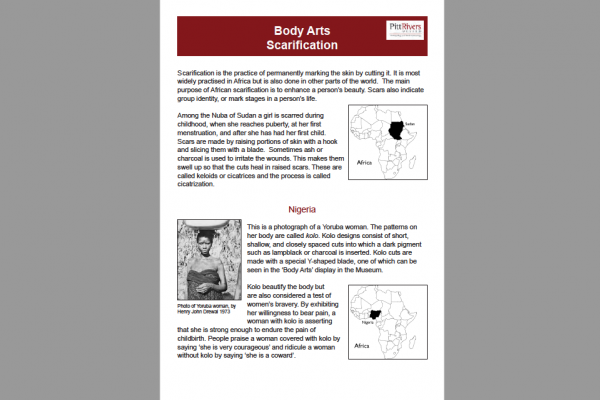
Among the Nuba of Sudan a girl is scarred during childhood, when she reaches
puberty, at her first menstruation, and after she has had her first child.
Scars are made by raising portions of skin with a hook and slicing them with
a blade. Sometimes ash or charcoal are used to irritate the wounds. This
makes them swell up so that the cuts heal in raised scars. These are called
keloids or cicatrices and the process is called cicatrization.
Nigeria

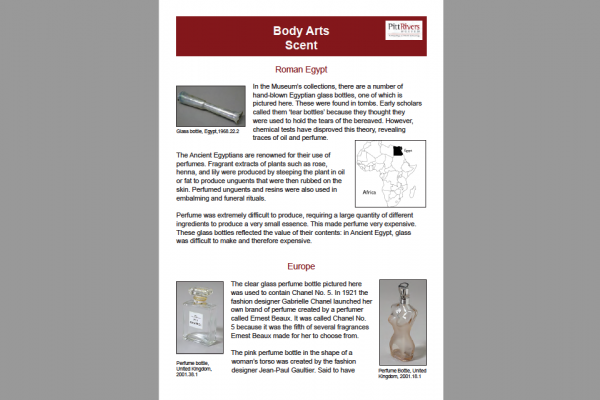
Photo of Yoruba woman, by Henry John Drewal1; 973
On the right is a photograph of a Yoruba woman. The patterns on her body are called kolo. Kolo designs consist of short, shallow, and closely spaced cuts into which a dark pigment such as lampblack or charcoal is inserted. Kolo cuts are made with a special Y-shaped blade, one of which can be seen in the ‘Body Arts’ display in the Museum.
Kolo beautify the body but are also considered a test of women’s bravery. By exhibiting her willingness to bear pain, a woman with kolo is asserting that she is strong enough to endure the pain of childbirth. People praise a woman covered with kolo by saying ‘she is very courageous’ and ridicule a woman without kolo by saying ‘she is a coward’.

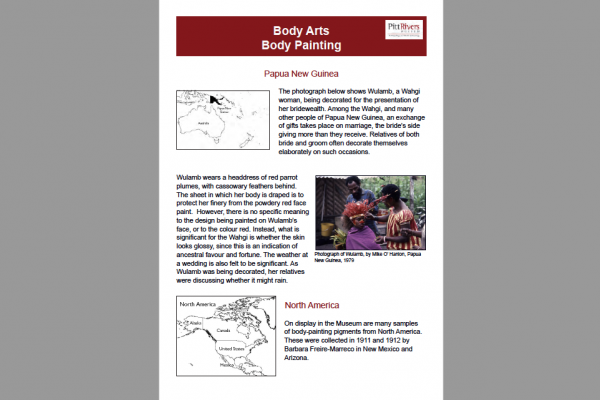
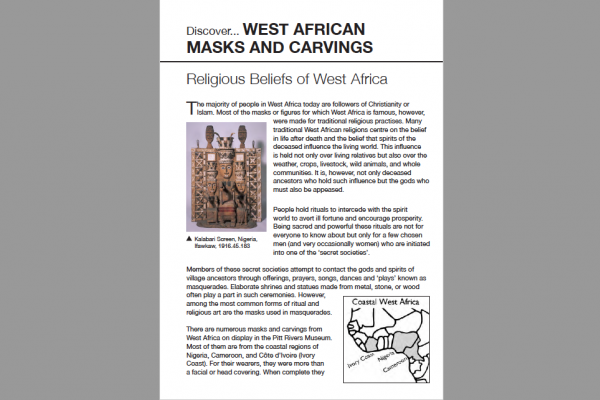
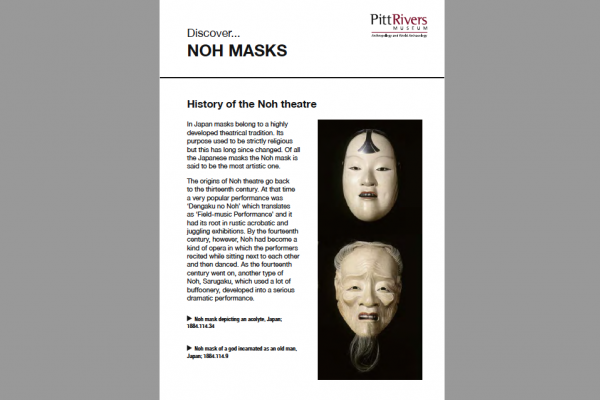
Tiv pottery head, Nigeria; 1932.18.7
This is an early twentieth-century pottery head with scarification marks
from the Tiv people of Nigeria. Amongst the Tiv scarification is necessary
for a person to be considered beautiful. Scarification styles change from
generation to generation. 
Scars on a woman’s stomach are also considered to be erotic. Because the scars remain tender for a few years after they are made, they are considered erogenous. It is said that a woman who has them will demand more sexual attention and therefore be more likely to have children.
Côte d’Ivoire

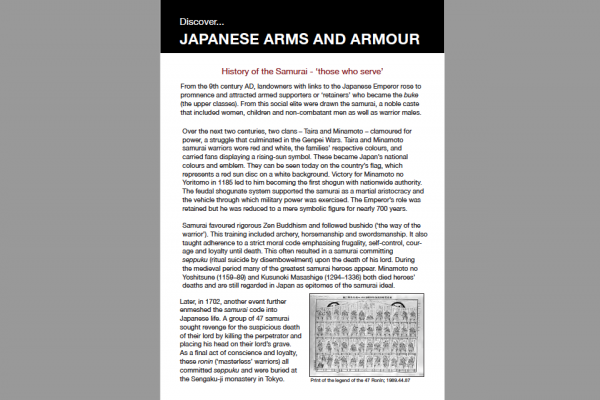
Photo of Senufo man, by Susan Vogel; 1980
This photograph is of a Senufo man from the Côte d’Ivoire with three linear scars radiating from the corner of his mouth. These scars are typical of the Senufo people.
Among their Baule neighbours, however, such scars are associated with something
undesirable. This is because at one time most slaves in the Baule territory
were Senufo. Because Baule people
make this association, they use this type
of scar to protect young children from harm; when a woman has had several
children who have died this scar is given to her next child so that Death
will not be attracted to it.
Further Resources
Body Art Collections at the Pitt Rivers: A website exploring the Body Art collections at the Pitt Rivers Museum. Here you can find out more about the objects on display in the Museum, about the themes of the displays, and about the people who made and used the objects.
Further Reading
Detailed information about each of the objects on display is provided in the Body Arts Gallery.
Sources
DREWAL, HENRY, ‘Beauty and Being: Aesthetics and Ontology in Yoruba Body Art’, in Arnold Rubin (ed.), Marks of Civilization: Artistic Transformations of the Human Body, Los Angeles: Museum of Cultural History, University of California (1998), pp. 83–96.
VOGEL, SUSAN, ‘Baule Scarification: The Marks of Civilization’, in Arnold Rubin (ed.), Marks of Civilization: Artistic Transformations of the Human Body, Los Angeles: Museum of Cultural History, University of California (1998), pp. 97-103.
Objects featured in this introductory guide can be found in the following cases:
First Floor (Lower Gallery) L37A for pottery head
Introductory guide compiled by:
Jennifer Peck, Project Assistant, DCF Redisplay Project, 2002
Introductory guide revised by:
Bryony Reid, Senior Project Assistant (Interpretation), DCF What’s Upstairs?, October 2005
Download print version of this introductory guide