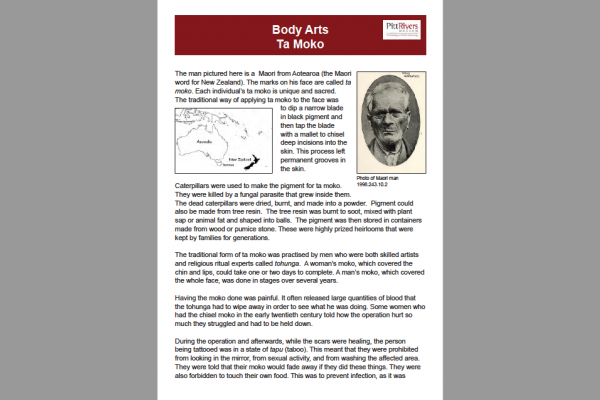
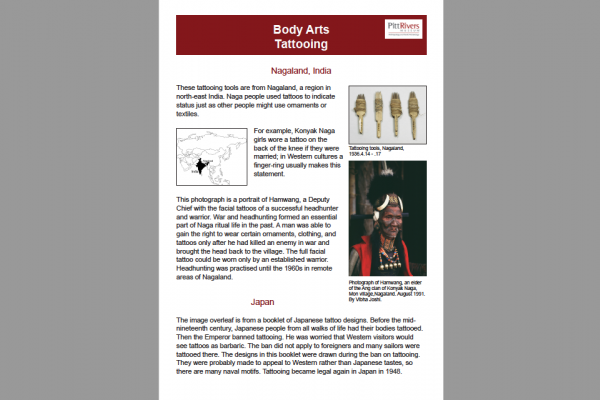
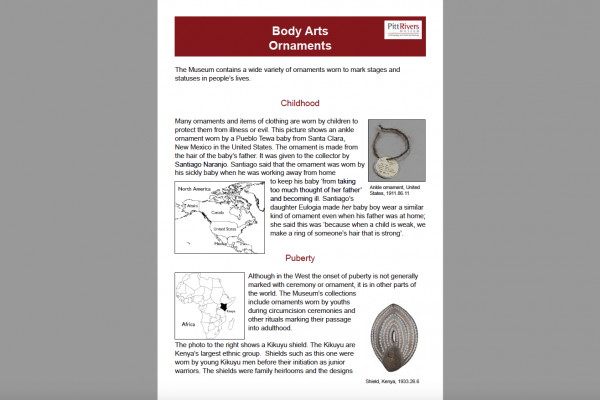
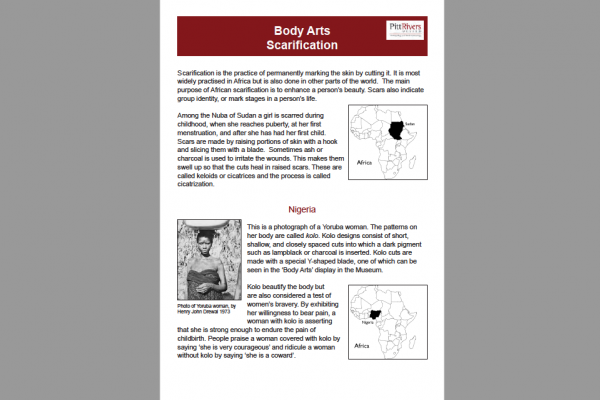
Amulets and Charms
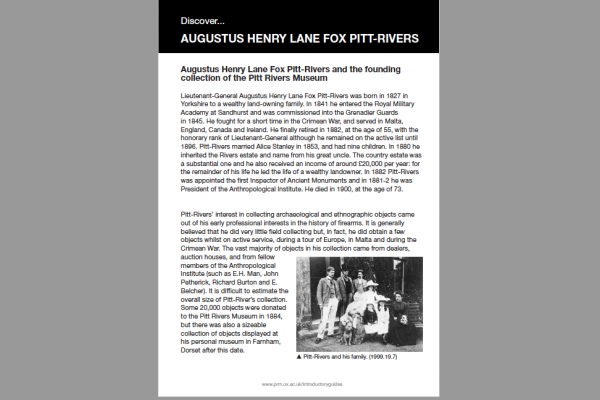
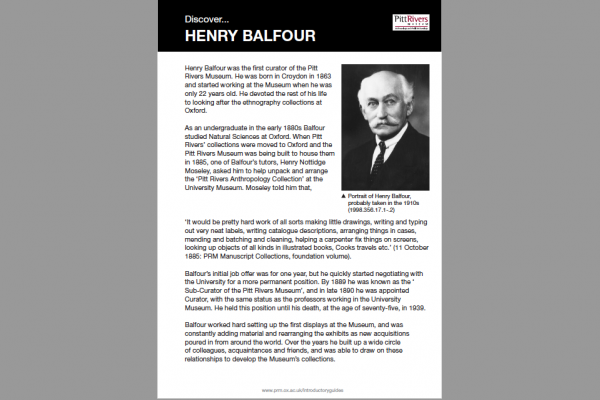
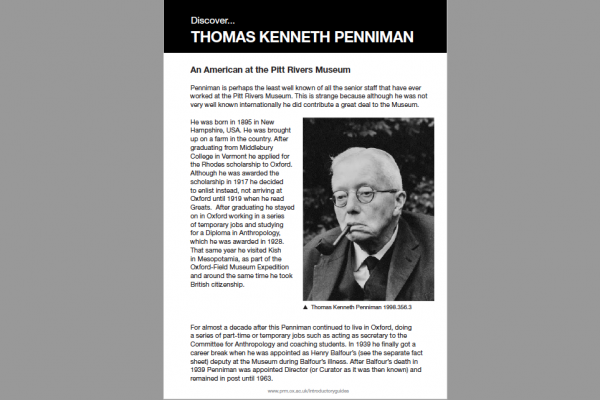
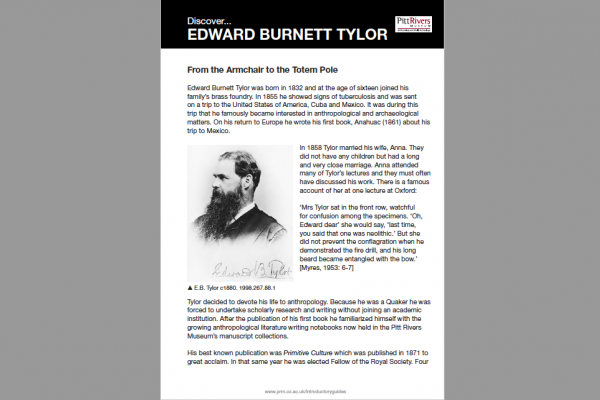
Introduction
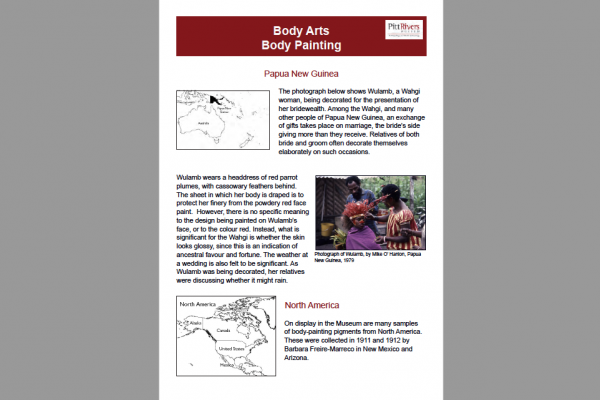
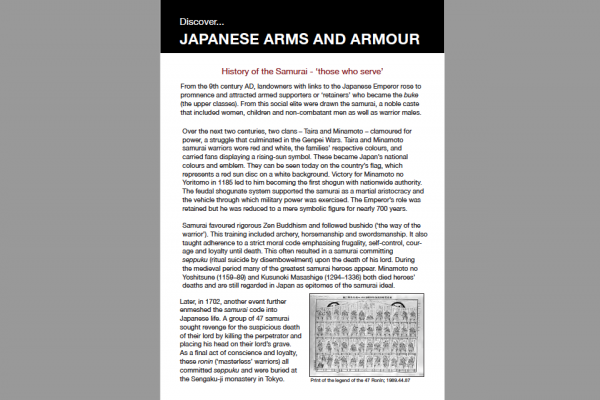
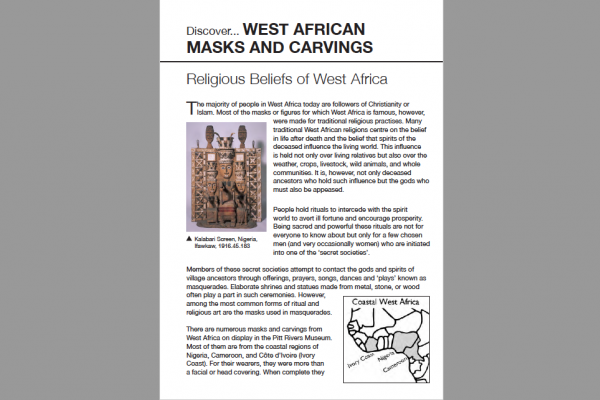
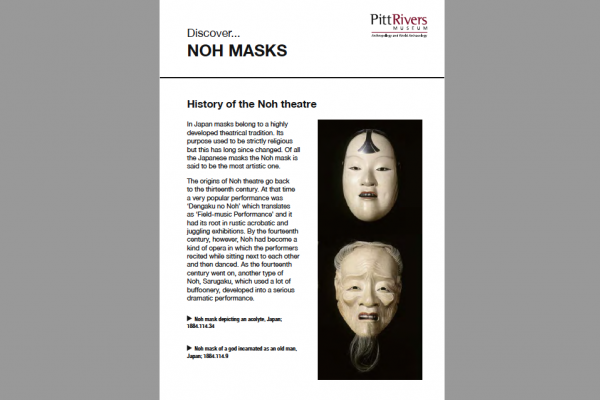
The Pitt Rivers Museum has almost 6,000 amulets and charms in its collections;
though not all of them are on display. They have been collected from all
over the world, including England, and demonstrate the wide array of methods
for using magic employed by different cultures.
An amulet is defined by the Oxford English Dictionary as: ‘Anything worn
about the person as a charm preventative against evil, mischief, disease,
witchcraft, etc.’ The definition of charm is very similar: ‘Anything worn
about the person to avert evil or ensure prosperity’, though a charm may
also be a spell or incantation believed to have a magical power.
Some of the objects on display are technically not amulets or charms but
objects that were used in a ritual or instilled with a supernatural power.
Some have been taken directly from the natural environment, and assigned
a magical function by a single person, while others have been carved or painted
to create an object with a meaning that would be recognised by most members
of the culture.
The underlying theme that unites all amulets and charms is that the people
who created and used them believed in them; almost any object may become
a charm or an amulet, so long as someone believes it has the power to affect
or alter the world around them.
Some amulets and charms are examples of ‘sympathetic magic’, which generally
means that the appearance of an object resembles, in some way, the cure or
protection it is believed to offer.
Unlike some of the objects on display in this Museum, amulets and charms
are still widely used in many cultures today. You may have an object yourself
that you trust will bring you luck! The amulets and charms on display at
the Pitt Rivers Museum are material evidence of the hopes and beliefs that
are shared by all of humankind.
Americas and Oceania
This tree bark – aimona - is an example of an object that was used for the magical purpose of inducing the love of a woman.Love magic in this region of the world is called vani, and typically involves an object upon which a spell is placed.The collector of this object, Diamond Jenness, received the Oxford University Diploma in Anthropology in 1910.
"Both the boy and the girl have recourse
to magic to ensure the abiding affection of the loved one.
D’Entrecasteaux Islands, Melanesia, Oceania;
PRM 1913.88.342 The youth will privately
sing over the tobacco he gives his fiancée to smoke, or the betel-nut that they
chew together; and the girl will do the same... Usually something else is mixed
with the tobacco, a scented leaf or root, or blood or dirt from the lover’s person.
It would really be quite difficult to win a girl without the vani, the magic
herb or mixture which evokes the pain of love." Diamond Jenness and A. Ballantyne, The Northern D’Entrecasteaux, Oxford: Clarendon Press (1920), page 98.
![]()
This is a narrow bag of woven cane, with
four shell rings placed around the middle, and a plait of pig’s bristles tied
to the looped end. 
Santa Isabel Island, Solomon Islands,
Melanesia, Oceania; PRM 1904.29.It contains the relics of the maker’s ancestors, and was probably
used with a magical spell intended to cause the death of an enemy. The Solomon
Islanders held their ancestors in great reverence, and also believed very strongly
in magic. Both their magical beliefs and their religious system were based on
the concept of mana, which has been defined by Starzecka and Cranstone as ‘Supernatural
power which can be present in varying degree in man and objects but always
derives from spirits. It is associated with anything ... outside the natural
order of things: exceptional success in business or talent for carving are caused
by mana, and an unusually shaped stone has mana’ (Starzecka and Cranstone 1974:
13).
This amulet is made from a dwarf coconut, carved with
clan motifs and rubbed with lime to emphasise the design. Known as marupai, such
amulets are still used for magical purposes in Papua New Guinea today.They are
usually passed from uncles to nephews, and the carved designs represent animals
and fish that are assigned to the various Orokolo clans. 
Orokolo, Papua New Guinea, Melanesia,
Oceania; PRM 1938.36.278 They are normally carried
in a small string bag, with the mouth and nose sticking out of the end. Aromatic
bark, flat seeds, or small pieces of bone from a magic man are sometimes stuck
in the mouth of the marupai to make it more powerful. They are used for many
magical purposes: keeping evil spirits away from gardens; for assistance and
good luck when hunting wild pigs; to magically draw specific types of fish to
the shore; to bring good health through disease protection; to bring good weather;
and, in some cases, to bring about the death of the owner’s enemies.
![]()

Queen Charlotte Islands, British Columbia, Canada,
N. America; PRM 1891.49.35This object was made by an artist of the Haida people who live on islands off
the west coast of Canada. Salmon are one of their main food sources, and this
object, made from wood and painted to represent a salmon, was used in a ritual
to draw the salmon up the river during periods when salmon were scarce. A chief,
carrying the carved salmon, and a shaman would lead the people to the beach.
The ceremony involved dancing and singing while the shaman addressed the water
spirits.
McDowell Reservation, Arizona, USA, N. America;
PRM 1911.86.111
This amulet comprises twelve shells (eleven Olivella intorta cypr and one Olivella biplicata Sby) and two glass beads (one green and one blue). It is an example of an amulet that has been given a meaning by its owner, who was a Mohave-Apache Native American. He used it to interpret messages received from the thunder during summer storms, and also for medicinal purposes. When he did not feel well, he blew on it.
Asia
This object was created to be placed in
the spring of a Rengma Naga village called Tesophenyu. The poisonous potions
of the Rengma Nagas were composed of a mixture of things taken from plants,
insects, 
Tesophenyu, Nagaland, India; PRM 1928.69.1584animals and their own bodies. Here the wrappings contain a mixture
of things that were considered powerful enough to cause malevolent events:
the hair of the witch who made it; earth from the grave of a man killed by
a tiger and a woman who died in childbirth; leaves of the agunnu tree, which
withers quickly; a piece of giant taro, which causes stomach irritation when
eaten; a nettle leaf; and a leaf of the tree known as the ‘flameof the forest’
because it sheds its leaves suddenly. Some of these items have a symbolic
magical meaning, and others are examples of sympathetic magic.
![]()

Tohoku District, Northern Japan; PRM 1976.10.5This charm, from a
Shinto shrine in Japan, comprises a packet of red silk decorated with gold thread.
It is meant to bring good luck and success in passing exams and other academic
endeavours. The Shinto religion is thought to be indigenous to Japan and is as
old as Japanese culture. There are no organised structures of belief or practice,
simply a system of cultural beliefs to help guide individuals through their lives.
Buddh Gaya, Bihar, India;
PRM 1892.41.280
This disc-shaped carved stone features at the centre an image of the
footprint of the Hindu deity Vishnu. Vishnu used his foot to assign the demon
king Mahabali to the underworld.

Myanmar (Burma), Asia; PRM 1949.8.1
This plaited cord has seven small figures of Buddha woven into it at
regular intervals. Buddhism is practised all over the world, but primarily
in India, Central and Southeast Asia, China, Korea, and Japan. This amulet
was worn to protect against death in battle.
Nigeria, Africa; PRM 1916.45.110
Africa
This object, know as an ikenga or personal god, from the Igbo people of Nigeria, consists of a stylised figure surmounted with metal horns. The body has two metal discs on top of a base covered with cowrie shells, with a bronze manilla (an open ring with enlarged finials) bound to one side. The forms of ikenga vary, but horns are usually represented in some way, and they are usually small so that they can be easily carried. This particular ikenga seems to have had some significance to blacksmiths, as the collector reported that they had been described to him as ‘blacksmiths’ mascots’, and would bring financial prosperity as well as protection from evil forces.
![]()

Ibadan, Nigeria; PRM 1930.34.1
This Yoruba amulet box or ori consists of woven leather strips and rows of cowrie shells as the base. It has three leather rings in the middle and three velvet rings (maroon, yellow and purple) at the top, with a red textile stopper. It was used as a container for amulets and charms. The original owner of this ori assured the collector that it is filled with ‘juju’, or protective amulets and charms, but could not tell him exactly what was inside.
This amulet comprises a rubber horse with a saddle, decorated withsmall
square pieces of red, green and yellow textile. It has a leather thong around
its neck with small ‘charms’consisting of pieces of wound metal wire. Thehorse’s
eyes are metal nails. It represents a ‘night 
Benue Wukari, Nigeria; Africa, PRM 1932.18.21horse’, and wasused in the
rituals of the Mba tsav secret society of the Tiv people of Nigeria. One of the
beliefs of the society was that they could mount this horse, become invisible,
and travel long distances at night in order to kill a victim and return unnoticed.
Objects of this kind were sometimes confiscated by the British Administration
when Nigeria was a British colony.
![]()
This amulet is made from the right scapula bone of a sheep, inscribed with Arabic writing. It is an example of using beliefs to ward off dangers that are present in the natural environment. It was collected by M. W. Hilton Simpson, who recorded that the writing, whether on bone or pieces of paper placed over the doors and windows of the home, offers protection against scorpion stings.
"Scorpions are said to be very plentiful in the area of the Djebel Cherchar
during the summer months, 
el Kantara, Aurès Mountains, Algeria, Africa; PRM 1920.42.15accordingly
we found similar charms in every native house as we progressed, but the pests
must be at least as common farther to the west, where the usual method of guarding
against their bite consists merely in the wearing of a charm upon the person,
certain scribes of the Aurès being believed to be capable of writing words and
signs upon a certain kind of bone which, if worn, will enable the wearer to pick
up by hand any scorpion unharmed."
M. W. Hilton-Simpson, Among
the Hill-Folk of Algeria: Journeys among the Shawia of the Aurès Mountains, London:
T. Fisher Unwin (1921), page 217

Kenya/Tanzania, Africa; PRM 1898.66.9This amulet, from the Maasai people
of Kenya and Tanzania, is made from ivory and was hung around the neck of a cow.
The Maasai are pastoralists who depend, for their diet, on the milk, blood, and
meat provided by their animals. Their cattle are thus essential to their survival,
which is why such amulets were used. In this case, the cow was probably being
protected from something similar to the Evil Eye, which the Maasai refer to as
inkonyek, or people with ‘eyes’. If an individual has ‘eyes’, he or she is able
to look right through the flesh of living things. If the person with the ‘eyes’
gets envious of what others have, they are able to poison people and cows with
just a glance. Their poisonous looks are especially deadly to young children
and calves.
![]()
This string of
red glass beads (possibly made in imitation of coral), with a red glass pendant
inscribed with a crescent and a star, was worn by an Egyptian woman whose spirit
was possessed by a sheikh. 
Al-Fayyum al-Lahun, Egypt, Africa; PRM 1933.58.8The sheikh was a holy person who had magical powers
when he was alive andwho was sometimes believed
to possess people after his death. This charm would cause the sheikh to treat
the woman kindly, and to prevent him from making her ill. If someone believed
they were possessed they could go to a magician who would interpret messages
from the sheikh and gave directions about what to do to please him.
This charm, consisting of powered ‘medicine’ within a rolled-up piece
of textile, was given to the collector, W. S. Routledge, to protect him from
lions. It was made for him by a Kikuyu medicine man around 1909. He wrote an
interesting account of this charm being made.
Mount Kenya, Kenya, Africa; PRM 1913.5.69
"A typically weird old man came to the camp with
his assistant and his small son. He brought his bag of medicines and a calabash
strung by four straps and terminating in a single thong; a stool was produced
and a mat, on which he spread his bottles. A charm being asked for by the
white man to preserve him from attacks of lions, the Medicine-Man at first
desired so to arrange its working that the moment the lion saw him it should
run away. The customer, however, explained that this would hardly answer
the purpose of being able first to obtain a good shot, and the medicine had
to be adjusted accordingly. The old man filled the calabash half-full of
water, and tipped powder out of each bottle into the palm of his hand. Into
this mixture he dipped his finger and drew it across his tongue in the form
of a cross; he then put the mixture out of his hand into the water in the
calabash, and a portion of it into each of the four divisions made by its
four supporting thongs, uttering meanwhile certain formulae. He then got
up and walked a few yards away, whirling the calabash and its contents round
and round his head, as if he were about to sling a stone, and addressing
each of the four quarters of heaven.
Red powder was taken out of one of the bottles, and with it was touched the
crown, ear, elbows, knees, and feet of the applicant; a black powder then followed,
and with it were anointed his shoulder, crown, knees, hair, feet, and head.
The performer took a quill from a bottle, touched some more powder he had put
in his hand, and stirred the brew with the quill, uttering incantations. He
then tasted the same powder, putting the quill in his mouth, and put it into
the brew in the calabash. The quill was also put in the mouth of the assistant.
The quill was waved five times round the patient’s head and touched his tongue
five times. The performers sipped the brew and spat; stirred the brew with
an iron instrument and tasted. The crucible was swung eight times round the
patient’s head, and he was made to taste the brew and spit once to right and
left and once in front, repeating the formula each time: ‘Bad beasts, do not
harm me.’ He was instructed to swallow a little, and the remainder of the concoction
was gulped down with great gusto by one of the native onlookers. Finally some
powder was tied up in a little package to be worn."
W. Scoresby Routledge, With a Prehistoric People: The Akikuyu of British
East Africa, London: Edward Arnold (1910), pages 269–70
Charms against the Evil Eye and Amulets as Cures
This section contains charms and amulets that were believed to be effective
in warding off the Evil Eye. As you can see from the variety of objects here,
and their provenances, belief in the Evil Eye exists throughout the world.
One of the earliest mentions of the Evil Eye is in a Sumerian text dating to
the 3rd–4th millennium BC. However, while belief in the Evil Eye may be widespread,
the actual amulets and charms used are usually unique to a particular region,
though ‘eye’ themes recur.
The Evil Eye is thought to be able to cause any kind of misfortune, illness,
or malady, even bad weather. Affliction from the Evil Eye can come from three
main sources: a compliment given by anyone, envy from one who has the Evil
Eye, or divine jealousy because of the good fortunes enjoyed by a mortal.
The cultural implications and codes of conduct that have resulted from this
fear of the Evil Eye are as varied as the amulets and charms themselves. In
some countries, babies and small children were kept covered in filth, in order
to prevent compliments or covetous glances. Eating in public also places one
in a dangerous position, which is why, in Spain, it is customary to wish another
diner Buen provecho; this assures the person eating that you are not envious
of his meal. In Islamic cultures it is customary to say Má shá’llah (What
God wills) and In shá’llah (If God wills) to preface a compliment, or when
speaking of some good fortune. This way, any beneficence is spoken of as having
been willed to happen by God. The wearing of charms and amulets is acceptable
in Islamic cultures, and they are often worn with the intention of attracting
the very first glance, which will then deflect any evil that might otherwise
harm the wearer.
Tunis, Tunisia, Africa; PRM 1917.9.74
The Hand of Fatima, here in gold
filigree, is a commonsymbol in Islamic countries. Fatima was the daughter of
the Prophet Muhammad, and was considered to be one of four perfect women. The
Hand of Fatima is a symbol of Muhammad’s family: the thumb is Muhammad, the first
finger is Fatima, the second finger is Ali (Fatima’s husband and the cousin of
Muhammad), the third and fourth fingers are Fatima’s sons Hasan and Husain. According
to some 
Hebron, Israel/Palestine, Asia;
PRM 1885.3.4sources, the Hand of Fatima is worn to protect from the Evil Eye because
it also represents the hand of the dead, with fingers that could potentially
pluck out the Evil Eye and thus blind it.
This glass amulet is meant to look like an eye, and thus uses sympathetic principles to attract the Evil Eye, protecting the owner from receiving a malicious glance. It has three concentric coloured rings (white, yellow and blue) surrounding a black ‘pupil’. It was donated to the Museum’s collections in 1885; but amulets of this kind continue to be manufactured and used in this way in many areas of the Middle East today.
![]()

Japan, Asia; PRM 1903.42.2
This object is called a hy-o-tan. It is an amulet consisting of a blown glass bottle filled with water and pieces of tinsel-leaf foil. A perforated shell (Trochus cinems) is attached to the bottle with a piece of string. Its phallic shape is meant to ward off the Evil Eye. This amulet would typically be worn by a child.
This
Syria, Asia; PRM 1913.73.15 amulet is in the form of a hand made from
silver, the palm of which is covered with writing in Hebrew. The Hebrew writing on this object indicates
Judaic origin. It was used to ward off the Evil Eye, and is evidence that belief
in the Evil Eye was common to both Jewish and Islamic cultures.
The Italian word cimaruta means ‘sprigs of rue’, which refers to the many
healing attributes of the rue herb. Hung from this branch are different charms.
The flower could represent either the rue flower, or artemisia, which is associated
with the protective forces of the moon.The crescent moon is a symbol of the
goddess Diana, who was, among other things, the special protector of childbirth.
The key also refers to Diana, because it was believed that Diana opened the
gatesof heaven in the evening, thus permittingthe moon to travel across the
sky until she closed the 
Cimaruta, Italy, Europe; PRM 1924.11.5gates each morning. Cimaruta are always made of silver, which
is another reference to Diana.
Cimaruta are powerful amulets that
were used specifically to protect children against the Evil Eye. They are called
compound amulets because they are composed of different symbols that are all
meant to provide protection from evil and harm.
In Italy it was believed that children are especially weak against the forces of malocchio (Evil Eye). The high infant mortality rate was more likely due to poor hygiene and diet, but it was attributed to the Evil Eye being cast on them by a jettatore. Jettatore is an Italian word of Neopolitan origin, and was used to refer to one who has the powers of the Evil Eye.
![]()

Abruzzi, Italy, Europe; PRM 1940.10.044
These two opercula shells resemble eyes, and are examples of objects that have
been taken from the natural environment for use as charms.
Naples, Italy, Europe;
PRM 1924.11.2
This cast-silver amulet of a mythological sea-horse or hippocampus, has five
pellet bells hanging from the body, at various points, and is suspended from
a silver linked chain. The hippocampus is a sea monster – a combination of a
horse’s forequarters with the hindquarters of a fish – with origins in Greek
mythology, where the hippocampi were believed to have pulled the chariot of Poseidon,
the god of the sea. In some cases, later features were added, including wings
and a single horn, as on this particular example. This object would have been
jingled to distract the gaze of a potential jettatore (purveyor of the Evil Eye)
from a baby.
![]()

Vanuatu, Oceania Melanesia;
PRM 1923.87.340.1-.2
These two dried sea-horses
are of the species Hippocampus abdominalis. It is unclear exactly what these
amulets and charms were used for. One of the only sources of information about
the use of sea-horses in this area comes from W. Wyatt Gill, who wrote about
his explorations of the South Pacific
in 1885.
"Two natives of Fate, one of the southern New Hebrides, on the occasion
of their baptism gave up to the teacher, who was named Toma, their gods.
These gods, to which daily worship had long been offered, were simply dried
sea-horses."
William Wyatt Gill, Jottings from the Pacific, London: The Religious Tract
Society (1885), page 221
Amulets against the Evil Eye Worn by Animals
This section contains amulets, charms
and objects that were used as cures for various ailments, most ofwhich are related
to the sea in some way. The 
Istanbul, Turkey, Asia; PRM 1903.7.1collection comes mainly from Italy, but there are
also some from Africa, Asia and Oceania, demonstrating that amulets and charms
of this kind also occurred in other parts of the world.
This amulet consists of a string of blue beads, intermittently strung with
five triangles of blue beadwork with tufts of red and white yarn at the points.
It was hung around the neck of a donkey, and would have been used to protect
it, as animals could also sometimes be victims of the Evil Eye.
References and further reading
Berry, Veronica, ‘Neapolitan Charms Against the Evil Eye’, in Folklore,
Vol. 79, no. 4 (Winter 1968), pp. 250–56.
Budge, E. A. Wallis, Amulets and Superstitions, New York: Dover (1978). Dundes,
Alan (ed.), The Evil Eye: A Folklore Casebook, London: Garland (1981).
Elworthy, F. T., The Evil Eye: The Origins and Practices of Superstition,
London: Collier-MacMillan (1958).
Gill, William Wyatt, Jottings from the Pacific, London: The Religious Tract
Society (1885).
Hilton-Simpson, M. W., Among the Hill-Folk of Algeria: Journeys among
the Shawia of the Aurès Mountains, London: T. Fisher Unwin (1921).
Jenness, Diamond, and A. Ballantyne, The Northern D’Entrecasteaux, Oxford:
Clarendon Press (1920).
Mills, J. P., The Rengma Nagas, London: Macmillan (1937). Paine, Sheila,
Amulets: A World of Secret Powers, Charms and Magic, London:
Thames & Hudson (2004). Routledge, W. Scoresby, With a Prehistoric People:
The Akikuyu of British East
Africa, London: Edward Arnold (1910).
Starzecka, Dorota, and B. A. L. Cranstone, The Solomon Islanders, London:
The British Museum (1974).
The objects featured in this Introductory guide can be found at the following locations:
Court (ground floor)
Case nos. C26A, C27A, C28A - Amulets and Charms
Case
no. C29A - Amulets, Charms, and Divination
Case no. C30A - Charms against
the Evil Eye
Case no. C30B - Amulets, Cures, and Charms
Case no. C31A - Magic
and Trial by Ordeal
Case no. C31B - Amulets and Charms for Animals
Further objects can be found in the many drawers below these cases.
Compiled by: Laura Phillips DCF Court Project, 2002–03
revised by: Kate White,
Head of Access & Public Relations March 2010
Download pdf version
of
this introductory guide
(to view pdf files Acrobat
Reader is required)